

“Water always seeks the lowest place. So it is with mercy. It flows to the lowest.”1
Sarah Carter introduced me to this quote a few months ago. And in the way the Good Spirit haunts me, it’s haunted me since.
Mercy, like water, always flows to the lowest point. Does this not illuminate the feast we are celebrating today?
I used to experience Holy Saturday as a day of sorrowful waiting. And in many ways, it is. The apostles were in mourning. Hopeless. Too exhausted and ashamed to do anything but nothing.
The Son of God died. Actually died. Not pretend death. Actual death. “He shared our radical poverty, which is death.” Mercy ran down to the lowest point.
But Mary must have known death hadn’t won.2 She knew that today was a day of liberation. “It is the day of the Paschal Mystery in which everything seems immobile and silent, while in reality an invisible action of salvation is being fulfilled.”3
The ancient icons of Holy Saturday depict that revelation we profess in the Creed: Jesus descended into hell…in order to liberate it.
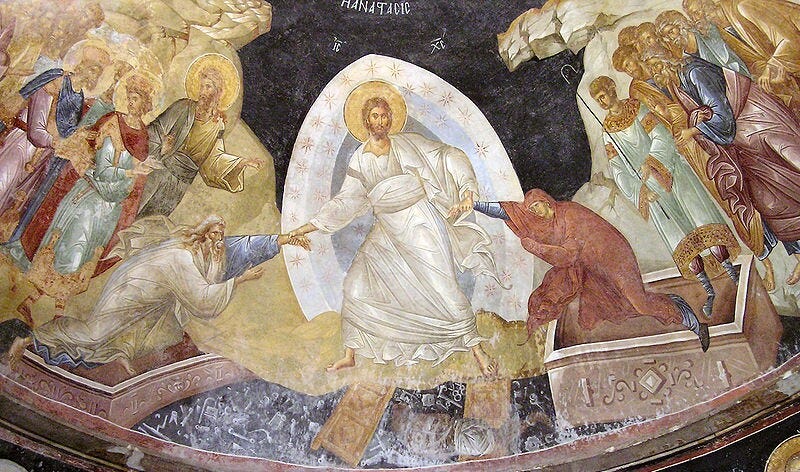
“This event, which the liturgy and tradition have handed down to us, represents the most profound and radical gesture of God’s love for humanity…He enters, so to speak, in the very house of death, to empty it, to free its inhabitants, taking them by the hand one by one.”4
Mercy flowed to the lowest point. “He wanted to sink so low that in the future all falling would be a falling into him.”5
In the process he broke down the gates of death, trampled the accuser, and, seeing his son far off, ran down the road to embrace Adam. There were no words of condemnation. No annoyance. No shame. Only liberation.
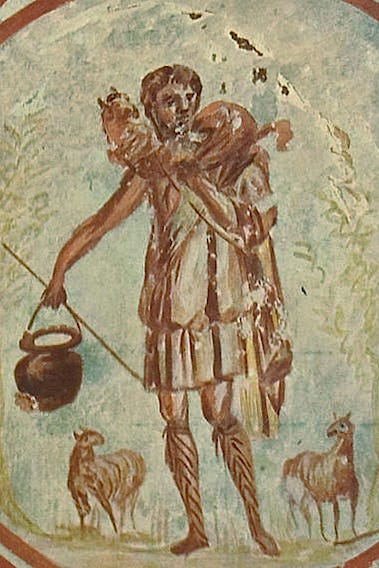
Like the shepherd who after searching—relentlessly, until he found it—for the lost sheep, bent down to the sheep and lifted it up onto his shoulders, rejoicing, Mercy looked into the eyes of the human who started all of this mess and said:
“Arise, let us go hence. The enemy brought you out of the land of paradise; I will reinstate you, no longer in paradise, but on the throne of heaven. I denied you the tree of life, which was a figure, but now I myself am united to you, I who am life. I posted the cherubim to guard you as they would slaves; now I make the cherubim worship you as they would God.”6
This event isn’t merely historical: it’s personal.
“Dear friends, this descent of Christ does not relate only to the past, but touches the life of every one of us. The underworld is not only the condition of the dead, but also of those who live death as a result of evil and sin. It is also the daily hell of loneliness, shame, abandonment, and the struggle of life. Christ enters into all these dark realities to bear witness to the love of the Father. Not to judge, but to set free. Not to blame, but to save. He does so quietly, on tiptoe, like one who enters a hospital room to offer comfort and help… He does so with full authority, but also with infinite gentleness, like a father with the son who fears that he is no longer loved.”7
God’s mercy flows—runs—down to the lowest part of my life. Christ rushes down to my greatest failures, where I’m most ashamed, where I experience the greatest weakness. And, like water, when Mercy reaches the bottom, it pools. It is in my poverty and powerlessness that I encounter Christ. “Blessed are the poor in spirit, for theirs is the kingdom of heaven.”
“Holy Saturday, then, is the day in which heaven visits earth most deeply. It is the time in which every corner of human history is touched by the light of Easter. And if Christ was able to descend all the way down there, nothing can be excluded from his redemption. Not even our nights, not even our oldest faults, not even our broken bonds. There is no past so ruined, no history so compromised that it cannot be touched by mercy.
“Dear brothers and sisters, to descend, for God, is not a defeat, but the fulfilment of his love. It is not a failure, but the way by which he shows that no place is too far away, no heart is too closed, no tomb too tightly sealed for his love. This consoles us, this sustains us. And if at times we seem to have hit rock bottom, let us remember: that is the place from which God is able to begin a new creation.”8
Fr. Jean Elbee, I Believe in Love: A Personal Retreat Based on the Teaching of St. Therese of Lisieux
I like to believe Mary Magdalene knew that as well
Ibid.
Hans Urs von Balthasar, Heart of the World
Pope Leo XIV, General Audience, September 24, 2025
Ibid.
Beautiful, Paul. I have dwelt in the mystery of Holy Saturday for many years now, since shortly before my brother, Tim, died by suicide. It's such a hope-filled day. Regis Martin’s The Suffering of Love: Christ’s Descent into the Hell of Human Hopelessness is a great resource. It's a mystery we would all benefit more from meditating on.
So beautiful and profound! Thank you!