

In her biography of Pope Leo, Elise Allen recounts an address that then-Father Robert Prevost gave in 2013 when he was the head of the Augustinian order. This was during the Augustinians General Chapter meeting, and the newly elected Pope Francis was present. The future Pope Leo said (emphasis mine):
“Some asked me, ‘What would you like the pope to say to the General Chapter?’ This made me reflect, and I am not sure of the answer, but I found one of Saint Augustine’s sermons that gives me words that might help. Here I quote Saint Augustine: ‘But if travelers rejoice in each other’s company on the way, what joy they will obtain in their home country! On this journey, the witnesses fought and they always advanced in the fight. They never gave up. By going forward, they never got stuck in one place. Those who love always move forward, and the path that we take requires sojourners.’
“This road rejects three types of people: those who stop, those who go back, and those who get off track. With the help of the Lord, our path has been protected from these three negative outcomes. Now walking together, one may go slowly and another may go faster, but both are moving forward. Holy Father, your presence in our midst will help us renew our commitment to move forward with decisiveness and love, thereby strengthening our ability to walk together alongside the whole Church.”
This passage has been on my mind as news of the SSPX schism has been in my newsfeed. In fact, speaking with the press about the SSPX in the weeks before their schism, Pope Leo said they “refuse to accept certain fundamental elements of the Church, starting with various points of the Second Vatican Council. If they make that choice, I am sorry, but we must move forward.”
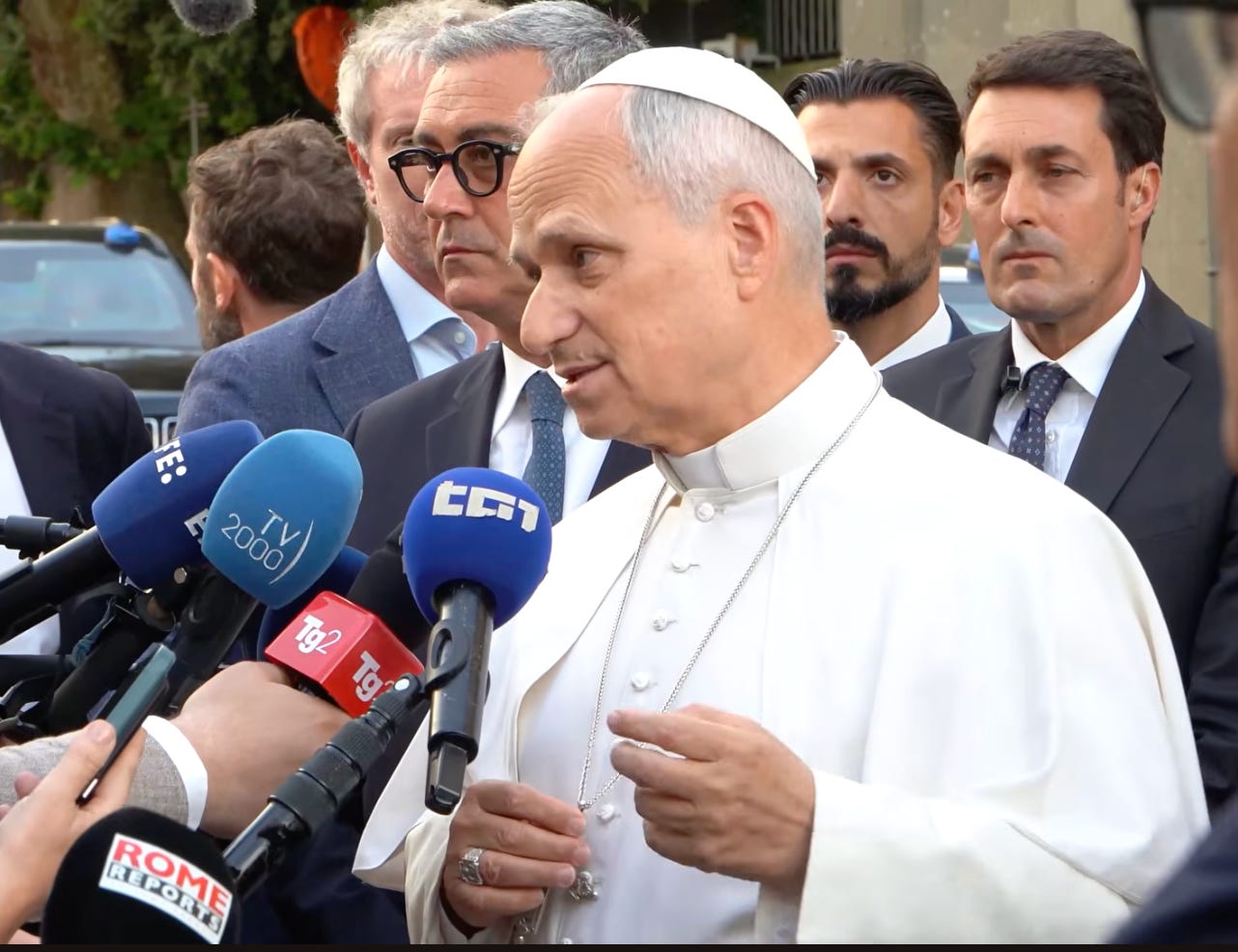
We must move forward.
The road rejects those who go back.
A year and a half ago, I wrote a catechesis about the Church’s teaching on development of doctrine. In light of all this, I want to share a long excerpt from it here in order to make the case that:
1. The core issue with the SSPX is, and has always been, a rejection of the development of doctrine and the authority of the living magisterium, not about liturgical preferences.
2. This core issue, while distilled and explicit in the SSPX, is present in wide swaths of the Church, including in many Catholics who are critical of the SSPX. The only differences are disagreement on when the rupture happened (Pope Francis vs. Vatican II) or on the specific doctrines being developed (the death penalty or matters of sexuality vs. religious freedom and ecumenism). In other words, the road not only rejects those who go back, but also those who stop. As Dei Verbum states, “the Church constantly moves forward” (DV 8).
Combination of continuity and discontinuity
In a 1976 letter to Archbishop Marcel Lefebvre, the founder of the Society of Saint Pius X (SSPX), Pope St. Paul VI said to the traditionalist prelate, “the concept of ‘tradition’ that you invoke is distorted.” Paul VI explained that Lefebvre understood Tradition as “a rigid and dead notion, a fact of a certain static sort” which “blocks the life of this active organism which is the Church.” Tradition, according to the pope, “is inseparable from the living magisterium of the Church.” This clarification that Paul VI offered Lefebvre is essential for understanding the doctrinal developments that came from Vatican II. It is also essential for the many Catholics today who believe that the Church’s teaching is unchanging and who, in turn, feel deeply uncomfortable with the idea that Church teaching could change in the future.
Those who believe that doctrine never changes often invoke Pope Benedict XVI’s teaching that we need to reject a “hermeneutic of discontinuity” with Tradition and instead embrace a “hermeneutic of continuity.” The trouble is that this is not what Pope Benedict taught.
The late pontiff’s teaching about contrasting hermeneutics came from a Christmas address he gave to the Roman Curia in 2005. There, he criticized a “hermeneutic of discontinuity and rupture” that sees the post-conciliar Church as disconnected from the prior nineteen centuries of Tradition. Furthermore, this hermeneutic pits the “spirit of the Council” against the “texts of the Council,” prioritizing the former as truly representing the will of the Council.
Pope Benedict contrasted this “hermeneutic of discontinuity,” not with the “hermeneutic of continuity,” but with a “hermeneutic of reform.” In doing so, he references Pope St. John XXIII’s 1962 speech that opened the Second Vatican Council. Quoting John XXIII, Benedict said: “The substance of the ancient doctrine of the deposit of faith is one thing, and the way in which it is presented is another.”
This distinction between the “substance” of doctrine and “the way in which it is presented” is crucial. The Dogmatic Constitution on Divine Revelation, Dei Verbum, picks up this distinction in a key passage about the development of doctrine: “This tradition which comes from the Apostles developed in the Church with the help of the Holy Spirit. For there is a growth in the understanding of the realities and the words which have been handed down” (Dei Verbum 8).
Here the Council Fathers draw a distinction between the “realities” of Divine Revelation and the Church’s understanding and expression of those realities. This is key: Pope Benedict—in that same Christmas address—said that “true reform” occurs when there is a “combination of continuity and discontinuity at different levels” (emphasis mine). In other words, an authentic understanding of Tradition does not insist on rigid continuity but rather embraces continuity in the unchanging substance of doctrine and allows for discontinuity in the way that substance is understood and expressed. Benedict used the Council’s teaching about religious liberty as an illustration of true reform, going so far as to say that this development was a correction of some historical teachings. By affirming religious liberty, Benedict said the Council “recovered the deepest patrimony of the Church” and was “in full harmony with the teaching of Jesus himself.”
Benedict acknowledged that there can be “apparent discontinuity” between contemporary magisterial teaching and historical teachings. However, rather than seeing this discontinuity as a rupture or a denial of Tradition, he believes that the discontinuity of understanding and expression ultimately led to a deeper preservation of the substance of Divine Revelation.
Right away, it is clear that the idea that Church teaching never changes is not shared by Pope Benedict or the Council itself. The Church can, and has, corrected some historical decisions of the Magisterium. However, in matters of doctrine, any contradiction or reversal with the past is only a discontinuity of expression, not a discontinuity of substance. That being said, the discontinuity of expression can look like a dramatic change in substance. St. John Henry Newman uses the example of a butterfly to illustrate this point. A butterfly looks entirely different from the caterpillar it used to be, but the dramatic differences do not change the fact that they are, at the deepest level, the same creature. Pope Benedict pointed to the Council’s teaching about religious liberty as an example of this kind of dramatic change, where the Church chose to “define in a new way” how Catholics ought to relate to other religions. The Church’s teachings about slavery, usury, and the possibility of salvation for non-Catholics are all further examples of where the Church teaching today looks, in many ways, like a reversal from what it taught in the past.
This understanding of reform is explicitly reaffirmed by Pope Francis in his response to the dubia submitted by five cardinals, including Cardinal Burke, in the lead-up to the 2023 meeting for the Synod on Synodality. The cardinals questioned the pope about whether Revelation “should be reinterpreted according to the cultural changes of our time” or if Revelation “is binding forever, immutable, and therefore not to be contradicted.” If you apply Pope Benedict’s understanding of reform to this question, the answer is obvious: the substance of Revelation is immutable, but the Church’s understanding and expression of Revelation can change. And that is precisely how Francis responded:
“Therefore, while it is true that the Divine Revelation is immutable and always binding, the Church must be humble and recognize that she never exhausts its unfathomable richness and needs to grow in her understanding. Consequently, she also matures in her understanding of what she has herself affirmed in her Magisterium. Cultural changes and new challenges in history do not modify Revelation but can stimulate us to express certain aspects of its overflowing richness better, which always offers more. It is inevitable that this can lead to a better expression of some past statements of the Magisterium, and indeed, this has been the case throughout history.”
Constantly moving forward
All of this raises the questions: How does the Church’s understanding of Revelation grow? How does doctrine develop and who develops it? Again, Dei Verbum is the key text. In the same section quoted previously, the Dogmatic Constitution affirmed that Tradition develops with and through the whole Church: from the prayers and lives of laypeople, to the study of theologians, and, ultimately, the teaching authority of the pope and bishops in communion with him. In other words, as Pope Paul VI said to Archbishop Lefebvre, Tradition “is inseparable from the living magisterium of the Church.” It is ultimately the Magisterium, and only the Magisterium, that definitively resolves any apparent contradictions because the “the task of authentically interpreting the word of God, whether written or handed on, has been entrusted exclusively to the living teaching office of the Church” (DV 10).
Further, Dei Verbum states that “the Church constantly moves forward” until “the words of God reach their complete fulfillment in her” (DV 8). Rather than seeing what is ancient as the greatest understanding of Revelation, the Council Fathers understood that as time progresses, the Church “moves forward toward the fullness of divine truth.” In a general sense, we have a greater understanding of Revelation now than we did in the 1500s, 1200s, or 400s. Here, the organic images of rivers and trees that St. John Henry Newman used can be helpful. A river is greater and more powerful at its mouth than in the small mountain spring that is its source. Likewise, a mighty oak tree is grander and stronger than a sapling. Pope Francis captures this growth in understanding, even to the point of correcting past teachings, in his response to the dubia:
“On the one hand, it is true that the Magisterium is not superior to the Word of God, but it is also true that both the texts of the Scripture and the testimonies of Tradition require interpretation in order to distinguish their perennial substance from cultural conditioning. This is evident, for example, in biblical texts (such as Exodus 21:20-21) and in some magisterial interventions that tolerated slavery (Cf. Pope Nicholas V, Bull Dum diversas, 1452).[1] This is not a minor issue given its intimate connection with the perennial truth of the inalienable dignity of the human person. These texts need interpretation. The same applies to certain considerations in the New Testament regarding women (1 Corinthians 11:3-10; 1 Timothy 2:11-14) and other texts of Scripture and testimonies of Tradition that cannot be materially repeated today.”
In other words, the living Magisterium is our interpreter of historical texts, not the other way around. We cannot appropriately use our understanding of past texts to judge the living Magisterium, otherwise, we end up severely misunderstanding and misrepresenting the Catholic faith. We cannot genuinely understand historical texts apart from the Church’s current teachings. The living Magisterium, working in dialogue with the faithful, is our only sure guide and interpreter of Scripture, Tradition, and historical documents, sifting through what is of perennial substance and what is the result of cultural conditioning (cf. DV 8). There is also danger in accepting an historic teaching as binding if it has not been repeated in generations because “frequent repetition” of a doctrine is one of the ways for us to know the importance of a magisterial teaching (Lumen Gentium 25).
This danger becomes clear if we try to imagine a catechist telling a new convert to Catholicism that “none of those who are outside of the Catholic Church” including “Jews, heretics, and schismatics” can be saved and all of them are damned to Hell (Council of Florence, 1442 AD); or a pastor telling his congregation that receiving any interest on a loan is gravely evil (Vix Pervenit, 1745 AD) but that slavery “considered in itself and all alone, is by no means repugnant to the natural and divine law” (Instruction of the Holy Office, June 20, 1866). Finally, imagine a Catholic school principal writing a bulletin article asserting that Catholic parents are forbidden to send their kids to public school without the permission of their bishop (Divini Illius Magistri, 1929AD). We must avoid reading past magisterial documents the way that fundamentalists read Scripture.
Hermeneutic of traditionalism: relativism and fundamentalism
In light of Pope Benedict’s “contrasting hermeneutics” framework, I would like to identify a third hermeneutic: the hermeneutic of traditionalism. This hermeneutic proposes that contemporary magisterial teachings must be understood and interpreted through the lens of historical teachings. This is a tempting hermeneutic because it appears solid and faithful. However, it is ultimately a type of subjective relativism and religious fundamentalism.
This hermeneutic of traditionalism presumes that individual Catholics have the ability and authority to interpret Tradition, which is what Newman said of Protestants who relied “upon their own personal private judgment” to interpret Scripture. In other words, this position posits that individuals can correctly interpret the Church’s historical teachings and judge whether or not the “living teaching office of the Church” has contradicted Tradition based on that interpretation. This hermeneutic is flawed because it makes the individual member of the faithful, and not the living Magisterium (the pope and the bishops in communion with him), the authentic interpreter of Tradition.
This distorted understanding of Tradition is also a kind of religious fundamentalism. It betrays a desperate need to have unchanging certainty in religious beliefs. Like the Protestant Christians who felt like their entire faith was threatened by the theory of evolution, within this Catholic fundamentalism is the fear that even the slightest deviation from historical teachings threatens the legitimacy of the entire Church.
Further, this hermeneutic of traditionalism is also related to the hermeneutic of discontinuity. Namely, it is defined by the idea that there is a Truth (i.e., Tradition) that can be abstracted from the actual texts of the Magisterium. As with the hermeneutic of discontinuity, the traditionalist hermeneutic holds that for the sake of faithfulness to the Truth, it may be necessary not to follow the teachings of the Magisterium. Ultimately, as Pope Benedict warned in his 2005 address, a hermeneutic of discontinuity “risks ending in a split between the pre-conciliar Church and the post-conciliar Church” because it asserts that the texts of the Council and post-conciliar teachings are not entirely faithful to the Truth of the Catholic faith.
[…]
Not just traditionalists
It is important to note that this hermeneutic of traditionalism with its distorted concept of Tradition extends far beyond members of the SSPX or Catholics who describe themselves as “traditionalists.” In fact, many Catholics who attend the reformed liturgy and say they support the teachings of Pope St. John Paul II and Pope Benedict XVI—many of whom even criticize “Rad Trads” for their excesses—have fallen prey to this false hermeneutic. They do this whenever they presume that any deviation between a teaching of Pope Francis and the teachings of his predecessors is a rupture with the substance of a doctrine and not a true reform with a mix of continuity and discontinuity.
One example of this fundamentalist understanding of Tradition comes from Cardinal Burke and his assertion that Pope Francis’s teaching about the possibility of Communion for divorced and remarried Catholics is a rupture from prior teachings. In fact, the cardinal expresses a distilled version of the hermeneutic of traditionalism in his 2019 interview with Ross Douthat. In reference to Amoris Laetitia, Burke said, “I haven’t changed. I’m still teaching the same things I always taught and they’re not my ideas. But now suddenly this is perceived as being contrary to the Roman pontiff.” The idea that one could not possibly be in schism because their beliefs have not changed rests on the premise that Church teaching cannot change.
Examples of this hermeneutic of traditionalism can also be seen in the criticism directed at Francis’s prohibition of the death penalty. Like the Second Vatican Council’s teaching about religious freedom, Francis’s magisterial teaching about capital punishment includes a “combination of continuity and discontinuity at different levels.” Some of the current pontiff’s teachings are indeed changes from those of his predecessors, but they are not ruptures. Francis is reaching back to deeper truths.
In 2018, the then Congregation for the Doctrine of the Faith (CDF) issued a “Letter to the Bishops” explaining the pope’s revision to the Catechism of the Catholic Church regarding the death penalty which said, “The new revision of number 2267 of the Catechism of the Catholic Church, approved by Pope Francis, situates itself in continuity with the preceding Magisterium while bringing forth a coherent development of Catholic doctrine” and “expresses an authentic development of doctrine that is not in contradiction with the prior teachings of the Magisterium” (7-8). In Fratelli Tutti, Francis said, “I sometimes wonder why…it took so long for the Church unequivocally to condemn slavery and various forms of violence. Today, with our developed spirituality and theology, we have no excuses” (Fratelli Tutti 86). Then he goes on to cite Scripture, Church Fathers, and past popes to demonstrate that his unequivocal condemnation of the death penalty is a reaching back to the deeper revelation that every human being has infinite dignity (cf. FT 264-265).
[You can read my whole essay here: https://wherepeteris.com/navigating-growth-and-development-in-a-living-tradition/]
*AI was used to edit this post
The MAGA Dream Team of the U.S. Catholic hierarchy
I think for me personally what is frightening is who claims to be the holder of truth and how it keeps getting distorted. I was around these folks when JP2 was still Pope and I was often deeply scandalized about how they spoke about him.
Now, I see flaws in JP2, for very different reasons. Which, I find is a painful part of maturity. They were 100% wrong, but they questioned, which is absolutely right. I sometimes wonder had their questions been explored and heard in the 80's if other practices would have also come to light saving thousands of children and adults from sexual predication.
It all seems to come back to was Vatican 2 valid, and if not, do the Popes operating under it keep their infallibility. It really brings me a lot of trouble in many ways. A school near me is opening up under the tagline, "a pre-vatican 2 faith". There is a deep belief that much of the trouble that was brought to light in 2002 was a result of Vatican 2, even though a majority of the crimes we're observing took place before the 70's and the rest by priests formed in the traditional liturgy *AND* traditional formation of doctrine.
This battle over the idea of constantly moving forward, I find, is often steeped in the cherry picking of not only current modifications but in understanding history. Too often it neglects the inconvenient parts of both liturgies and teachings that were a shock (or scandal) to some. For instance, the Iroquois Mass or the Salvonic masses in the vernacular or the definition of usury. One of the things that I have to find some irony two popes *before* Pius X is the one who indicated that salvation can be found outside the church if one is invincibly ignorant of the church.
I will say, I've got an unpublished piece on Pius X Oath against Modernism and I do wonder how that inter-plays with what's going on now. My working theory is that it is much more like JP2 than those in the SSPX find comfortable, in that it questioned the wrong thing but highlighted something wrong. To me, very much the wrong and extremely contemptible against the primacy of conscience. However, I do wonder if the power of that level of control is what is still being sought.