

Today, July 9th, is St. Mark Ji Tianxiang’s feast day.
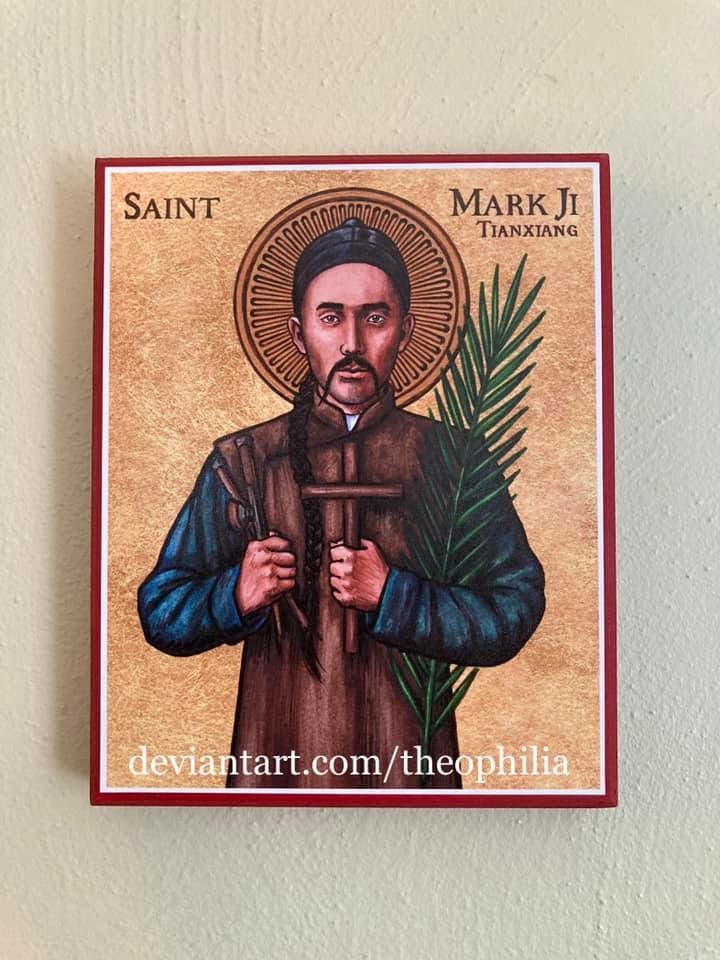
St. Mark was born in China in 1834. He was a physician who served the poor but who himself became seriously sick in his 30s and treated himself with one of the common medicines of that time, opium.
That begin an addiction that lasted for decades. He would frequently go to Confession, but eventually his priest confessor told him that he wasn’t serious enough about quitting so he denied Mark absolution and access to Communion.
Mark lived the rest of his life without access to the sacraments. He died a martyr in 1900 during the Boxer Rebellion, still an addict, still unable to receive the Sacraments.
There are two things I want to highlight from St. Mark’s story.
The first is that even though he lived for decades in what some would call the state of objective and public sin, Christ still gave him grace and made him holy. I recall this passage from Pope Francis:
“Nor can we claim to say where God is not, because God is mysteriously present in the life of every person, in a way that he himself chooses, and we cannot exclude this by our presumed certainties. Even when someone’s life appears completely wrecked, even when we see it devastated by vices or addictions, God is present there. If we let ourselves be guided by the Spirit rather than our own preconceptions, we can and must try to find the Lord in every human life” (Gaudete et Exsultate 42).
St. Mark’s drug use may have been grave matter, but they were not mortal sins. His actions were not separating him from God. On the contrary, he was living so much in union with God that grace transformed him to the point that he was able to freely die a martyr.
Second, I was struck by the pastoral failure of his confessor who denied St. Mark absolution and the Eucharist because he didn’t think that Mark had “firm purpose of amendment.” Now, the priest, didn’t have the advantage of modern psychology and the knowledge that drug addiction is a disease, not a moral failure. The priest’s decision to withhold the sacraments from St. Mark was still objectively unjust and caused real harm.
But God was still able to work. While St. Mark was denied the source and summit of God’s grace, God himself was not bound by His sacraments.
I think that St. Mark’s story is a source of hope for those caught in addictions, habits, and relationships that bind their freedom, who feel like their grave actions are preventing them from a life of real holiness.
He is also a source of hope for those faithful being unjustly governed by their pastors. His story is a reminder that even when religious leaders utterly fail as pastors and leaders that God’s grace can, and does, continue to heal and transform the Church.
You can buy this icon, and check out more great Catholic artwork from Cecilia Lawrence, here: https://www.deviantart.com/theophilia
Read more about St. Mark’s story here:
https://www.osvnews.com/2019/10/24/the-life-of-st-mark-ji-tianxiang-persevering-in-faith-despite-addiction/
St Mark Ji Tianxiang is also a hope for someone who is being or was at some time spiritually abused. It is also a rebuke of clericalism, and a vindication of the primacy of conscience. St Mark being told he sinned mortally when he had not, and the priest refusing confession or to explain that it was not mortal sin, is an imposed scrupulosity. The clericalism is in the claim that the priest’s erroneous judgement that forgiveness was impossible supersedes the individual conscience and desire for forgiveness.
So why did the priest refuse to allow confession? I have a theory: because priests who served in China at the time were largely from France, it can be inferred that he had a devotion the Sacred Heart. If you look at the promises of the Sacred Heart, the logic becomes clear:
1) Christ promised that priests would inflame hearts, give graces, and lead those under their care to repentance.
2) The priest saw no evidence that the promises were being fulfilled in Mark’s life
3) The promises do not undo the free will, and require the parishioners to have basic intent and desire to repent.
4) From the above the priest inferred that there was no desire or intent in Mark to change his life, and certainly not firm intent.
5) From 4, he refused to offer confession, because absolution requires firm intent.
Not understanding Addiction isn’t even an excuse for this, because it is addressed in Aquinas on drunkenness (among other theologians of his era and before) and so would have been part of his education. This provides sufficient knowledge in the priest. Grave matter is in refusing confession. Intent is in refusing confession for a long time.
Why would the priest think he had the right to do this? Because at the time priests were told they were ontologically different and superior to laity, not merely given a mark from Christ, a change to the accidents of the soul not an essential change.
Another element: the belief in racial or national superiority, that Europeans were better than Chinese; and the interrelation between colonialism and missionary work. If you can’t go to confession, there is one sure way to get to heaven: martyrdom. This opens up a disturbing possibility, that the priest was intentionally producing the conditions in someone that will produce a martyr. The production of hagiography quickly after martyrdom suggests that it was planned for or at least anticipated. Martyrdom was used frequently as cause to invade, civilize, and colonize. If so, it is possible that the priest created someone who would be a dramatic martyr, so martyrdom would be useable for someone to conquer and colonize China, to make conversion of China easier.
Like Saint Bartolo Longo, Saint Mark Ji Tianxiang is one of my favorite examples of holiness because God showed up in his life in a way that shows how much God loves each of us and doesn't give up on anyone. He is also a patron at Divine Mercy University where I did my spiritual direction certificate. They have an image of him in the chapel.