

Last fall, Pope Leo published his first major teaching document, the Apostolic Exhortation, Dilexi Te. This document has primarily been presented as a moral exhortation for Christians to better serve the poor. While this isn’t untrue, I think Pope Leo’s inaugural teaching letter is much more. In Dilexi Te, Pope Leo presents us his programatic vision of the Church.
For the bulk of Dilexi Te, Pope Leo surveys Scripture, the Church Fathers, centuries of Saintly witnesses, the Church’s body of social teaching, Vatican II, and post-councilar papal documents to demonstrate how the character of God and the nature of the Church is expressed in the doctrine of the preferential option for the poor.

In this theology, God isn’t a judge demanding that the debt of humanity’s sin be paid, such that Christ has to appease or protect us from an angry father. Not at all. Rather, “God is merciful love” (DT 16), a Father “who is always concerned for the needs of his children, especially those in greatest need” (DT 8). God is a liberator, who looks at humanity with “a merciful gaze and a heart full of love” and desires to “free us from slavery, fear, sin and the power of death” (DT 16). Pope Leo says:
“Precisely in order to share the limitations and fragility of our human nature, he himself became poor and was born in the flesh like us. We came to know him in the smallness of a child laid in a manger and in the extreme humiliation of the cross, where he shared our radical poverty, which is death” (DT 16).
Christ, Leo goes on to say, “reveals himself as the One who, in the here and now of history, comes to bring about God’s loving closeness, which is above all a work of liberation for those who are prisoners of evil, and for the weak and the poor” (DT 21). And from this revelation of God, Leo expresses the identity and mission of the Church:
“Wanting to inaugurate a kingdom of justice, fraternity and solidarity, God has a special place in his heart for those who are discriminated against and oppressed, and he asks us, his Church, to make a decisive and radical choice in favor of the weakest” (DT 16).
And here, in this understanding of God and the Church—shaped by Vatican II and Latin America, and rooted in the preferential option for the poor—is where Dilexi Te says something new and provocative, at least to the ears of American Catholics.
A Church Without Enemies
Leo proclaims that “since apostolic times, the Church has seen the liberation of the oppressed as a sign of the Kingdom of God” (DT 59) and “the mission of the Church, when she is faithful to her Lord, is at all times to proclaim liberation” (DT 61).
The Church needs to be “simpler and more sober,” rejecting “worldly powers” and “more closely resembling her Lord” (DT 84) who “became poor, and was always close to the poor and the outcast” (DT 111). A Church that does not only see the poor and marginalized as “just people to be helped” but “the sacramental presence of the Lord” (DT 44).
Pope Leo is calling the Church to embrace the preferential option for the poor, not by wrestling for spaces in the halls of political power, but by identifying with the most marginalized in our society. Dilexi Te is a prophetic call for the Church to stop getting defensive when the world mocks us, but to spend our energy defending the basic human rights of migrants. It’s a call to stop using the pretense of religious liberty to protect clerics and mistreat lay employees. It’s a call for our parishes and schools to be radically inclusive (cf. DT 72, 99), not fortresses of purity and self-protection. It’s a call to stop hiding behind lawyers to shield ourselves from lawsuits, acting as if abuse survivors were enemies and not the sacramental presence of Christ.
In Dilexi Te, Pope Leo XIV picks up the mantle of Pope Francis and says, without any doubt, that we must be a poor Church for the poor. He is calling for us to be a Church without enemies. “The Church that the world needs today,” Leo proclaims, is “a Church that sets no limits to love, that knows no enemies to fight but only men and women to love” (DT 120).
There’s More!
Would you like to learn more about Pope Leo’s vision of the Church? Would you like to dive into Pope Leo’s exhortations, catechesis, and encyclicals with a small group of people invested in both learning from and being formed by what the Holy Father is teaching us today? Sarah Carter and I invite you to join the Leo Seminary: a space where people could read Pope Leo’s actual words, in community, without an ideological agenda.
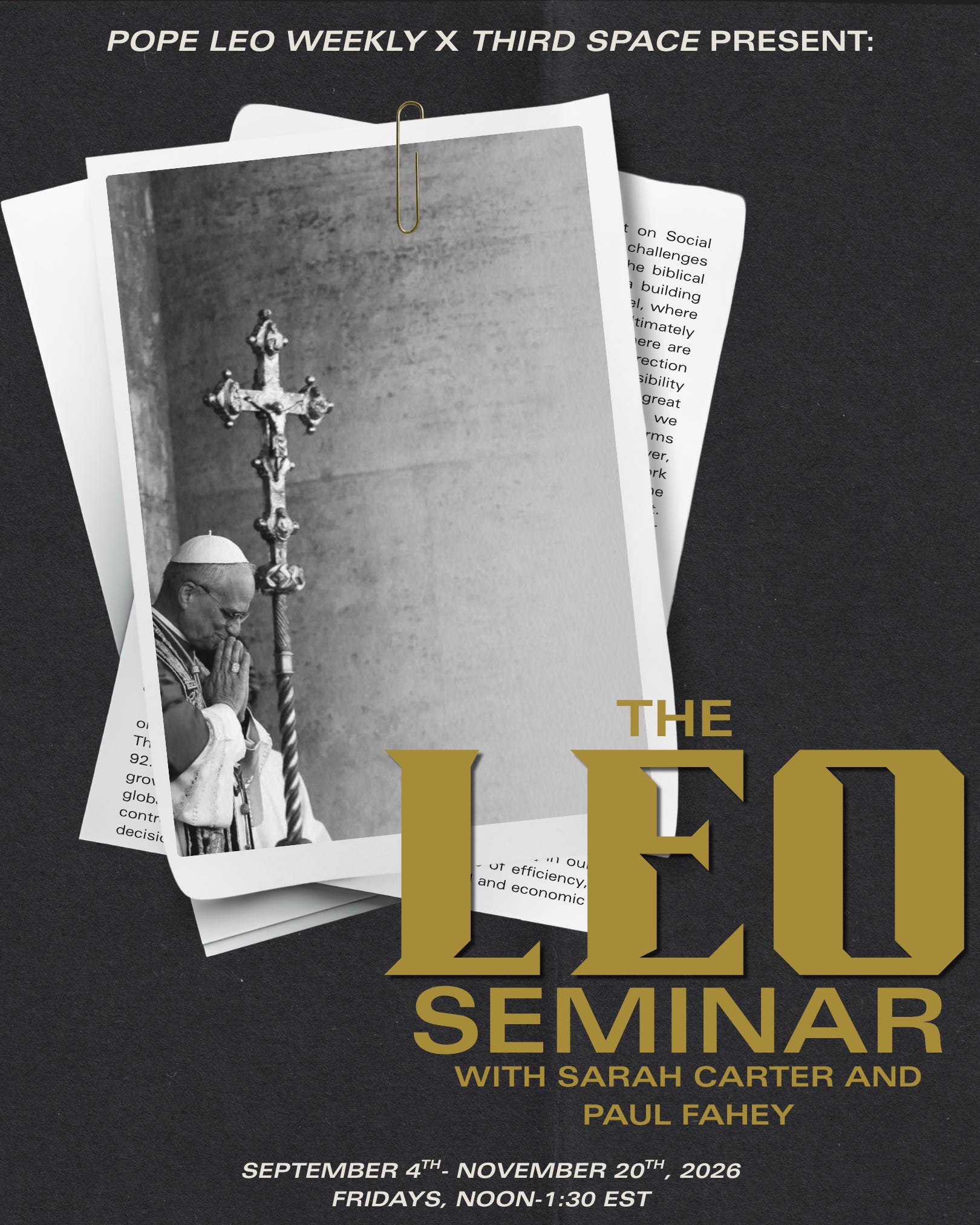
Sarah and I believe that striving for integrity is more important than having the right answers; dialogue and curiosity are more important than ideological purity; unity in diversity is more important than uniformity; “truth is not a territory to be defended, but a good to be shared” (Magnifica Humanitas 25); and “realities are greater than ideas” (Evangelii Gaudium231).
The Leo Seminar exists for anyone who wants to step into a process of collective study and discernment instead of consuming “hot takes.” In this seminar, you will spend twelve weeks digging into primary texts, guided discussion, and honestly wrestling with what Pope Leo is actually saying and where he’s leading the Church.
You won’t leave with a verdict handed to you, but you’ll have the opportunity to form your own conclusions in a community of people who take the questions as seriously as you do. People who are willing to undertake this kind of slow and serious formation will be agents of renewal in the Church, more equipped to proclaim the Gospel in the modern world.
Registration closes in 10 days! So sign up now!
About The Leo Seminar
The Leo Seminar is a small group online seminar starting on Friday, September 4 at 12:00 (ET). The group will meet every week for 90 minutes, for 12 consecutive weeks. Sarah and Paul will lead each discussion, and we will have occasional special guests, including Pope Leo’s biographer, Elise Ann Allen!
Who The Leo Seminar for:
Catechists
Teachers
Clergy
Parents
Catholics
Non-Catholics
Anyone who wants to better understand the mind and teaching of our new pope
What we’ll be reading together:
Pope Leo XIV: The Biography by Elise Ann Allen
Evangelii Gaudium by Pope Francis (programmatic document that has set the stage for Leo’s pontificate)
Magnifica Humanitas (On artificial intelligence)
Dilexi Te (On love for the poor)
In Unitate Fidei (On Christian unity)
Other selected homilies and addresses form Pope Leo
What you’ll get when you enroll:
A copy of Pope Leo XIV: The Biography by Elise Ann Allen sent directly to your mailing address
A 60-minute, live, “closed-door” Q&A with the first and only person to be granted an exclusive interview with Pope Leo XIV, Elise Ann Allen
The Leo Seminar Reader, a digital reading packet designed for ease of use and note taking
Twelve 90-minute sessions, with in-depth analysis and discussion
A community to study and discuss with, and opportunities to stay connected after the seminar ends
When we’ll meet:
Every Friday from September 4 - November 20
All meetings from 12:00-1:30 p.m. ET
Cost:
$1,200 (with options to pay in installments via Stripe)
*The deadline for registration is August 28
About the hosts:
Paul Fahey is a professional counselor, writer, retreat leader, and podcaster. He previously worked as a lay minister and catechist in the Catholic Church. He has an undergraduate degree in Theology and a MA in Clinical Mental Health Counseling. He provides counseling for those who have been spiritually abused and creates resources for Church leaders to better safeguard their communities against abuse.
Paul created the Third Space podcast, the Pope Francis Generation podcast, and co-founded Where Peter Is. He has published articles and resources about spiritual abuse, Catholic social teaching, and pastoral accompaniment.
Paul lives in SW Michigan with his wife and five kids. His favorite saints include Maximilian Kolbe, Dorothy Day, Óscar Romero, Mark Ji Tianxiang, Josephine Bakhita, and the Ulma Family.
Sarah Carter is a writer, teacher, and theologian with a masters degree in Theology and over a decade of experience working in Catholic institutions, including as a policy ghost writer for the Minnesota Catholic Conference (MCC) and the United States Conference of Catholic Bishops (USCCB).
Sarah’s work has been focused on an integrated approach to Catholic social teaching and the intellectual formation of both lay and ordained leaders. She has taught several courses and seminars in Catholic theology at both the high school and university level.
Sarah lives in the Twin Cities metro area with her husband and three children. In her spare time she enjoys knitting, exercise, and reading.
Frequently Asked Questions
Do I have to be knowledgeable about the pope and Catholic theology to enroll in this seminar? No. If you want to read and discuss Pope Leo XIV in community with other people, you are welcome to enroll no matter your level of familiarity with Catholicism or your educational background.
Is this seminar for Catholics only? Again, nope! Anyone interested can enroll. In fact, we’d love to welcome some non-Catholics into the conversation!
What if I don’t like the pope or agree with what he’s saying? We don’t see our role as trying to defend everything the pope has ever said or taught. We’re here to help participants engage honestly with Pope Leo’s teachings and his vision, regardless of whether they agree with it or not. In other words, our goal is for you to know what Leo is saying and where he is guiding the Church–whether he’s right or wrong, we leave to you to judge.
Will you offer discounts? At this time, we cannot offer discounts on The Leo Seminar. Stripe (the payment platform) does offer pay-over-time options. I’m always trying to balance my desire to make my resources available to anyone while also providing for my family. The income from this seminar helps allow me to continue to offer my Spiritual Abuse Workshop at little-to-no cost for those who can’t afford it.
How many spots are available in this seminar? Since we want this to be a small, discussion-based group, we have decided to cap The Leo Seminar at 15 participants.
Right on. Great work as always.