

In navigating my own experiences of abuse and betrayal in and by the Church—and accompanying others as they navigate these experiences and the impact of them— there's an image that's been helpful that I wanna share. And it's a way of hearing Plato's Allegory of the Cave.
If you haven't heard of Plato's Allegory of the Cave that's fine (And I will probably butcher it here, so go look it up online). In the Allegory of the Cave, Plato's trying to make a case for his philosophy of reality as we experience it versus the realm of the, the forms, of things that are more real more true. And he paints this image of how we are like people trapped in a cave, and there's light at the front of the cave shining in, and we don't see reality in and of itself. We see shadow puppets cast on the wall. We see shadows of trees and shadows of dogs.
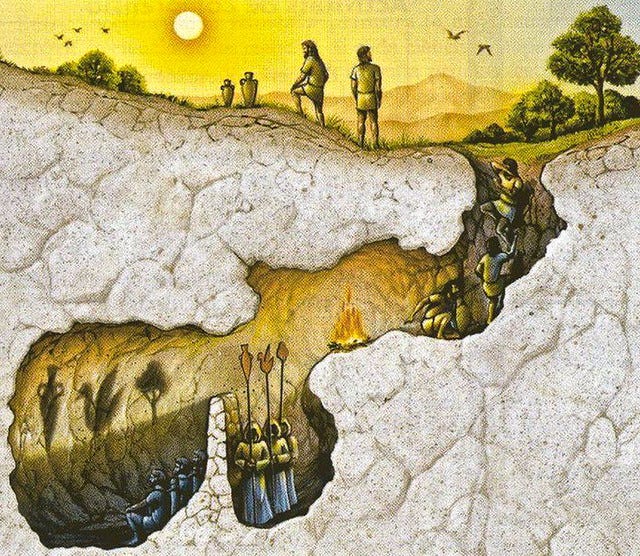
Say someone is unchained from their tether in the cave and dragged out. He comments on this process of being unchained, and you're looking at the light and being dragged out of the cave, as extremely painful, right? Our eyes burn as we look at the light directly. We get all scraped up as we are dragged out of the cave. And we're dragged out into the real world and see things as they are. We see dogs and we see trees, not just shadow puppets of them. And we see the sun and our eyes hurt. The things are so real.
I think of C.S. Lewis in The Voyage of the Dawn Treader, where as they get closer to Aslan's land, like, the water becomes more wet, the things become more real, and they're sharp. It's painful.
My experience of abuse and betrayal in the church, and so many other people's experiences, led to what could be called a deconstruction, a questioning of reality as we knew it, a questioning of God, a questioning of the Church. And this process of betrayal and moral injury is extremely painful. People we once trusted, we don't trust anymore. Our own sense of God that we once, that we once relied on for so much, we don't feel like we can rely on anymore.
And in this process, though, we come to see things. We come to see the reality of the Church more for what it is And it's not a pretty reality. What's more true about the Church are the systemic injustice, the structures of abuse and cover-up and betrayal. The preferential option for the institution, for self-protection, over and above a preferential option for the vulnerable and the marginalized. We see not just human failure, but some of the worst of human evil instantiated in cultures and structures in the Church, and it's ugly.
Not all of it's ugly. Some of the most beautiful parts of this seeing reality more as it is, for me, has come from being able to encounter Christ in the marginalized, in the vulnerable. And I've experienced Christ in ways in my relationships with them that…I've had experiences of Christ that I've never had before, that have been life-changing for me. And I wouldn't wanna go back.
I mean, maybe on some days, like there's the thought of the pleasant fiction of, you know, the Church really isn't that bad. Seems nice on some days. But in reality, I couldn't go back because I know that that's a fiction now.
And then also trying to go back into the cave to help others see things as they are is also a really painful experience. Plato talks about how the enlightened person who went outside comes back into the cave to try and rescue people, and they're perceived as an idiot or treated with violence, right? They become a martyr. I think of Jesus' words that a prophet is not welcomed in his own town, right?
Coming back to share with others, to try and unchain others from the fiction that they see. To say, "No, here's how it really is. There's more. It's painful to see, but it's also more real and more true. Don't you want what is more real and more true?" And the reality is that a lot of people don't or aren't able to see what is more real and true yet. That the painful process of getting there is maybe too much for them, and they refuse. And that just furthers the feelings of isolation for survivors
If you find yourself standing outside the cave looking at things that are more real, and they're painful to look at. Maybe see if you can find others standing out there with you. People who you may not have…people you may have misjudged in the past, but who see things more as they are.
Find people who can hold space for both the good you've experienced and the ugliness and the harm it is more lonely outside the cave. But you are not alone outside the cave.
LOVE this reflection Paul. Thank you so much for sharing it. Peace, Colin
Thanks Paul. That resonates.
People, including clergy, whom you trusted, when informed of a betrayal that took place in the church, chose to prefer the status quo over love, justice and mercy. They chose the shadows over light.
You are right. There is no going back to what once seemingly held together. You now see how "upstanding" laity and priests alike, whom you once trusted implicitly, have turned a blind eye. They had no interest in knowing the truth. Instead their own interests were their interests.
However, like you say, you now know, or to use Plato's analogy, "see" people for who they are. It's awful, but it's the truth.
What is left, then? Or rather, who is left? The Betrayed outsider Himself.