

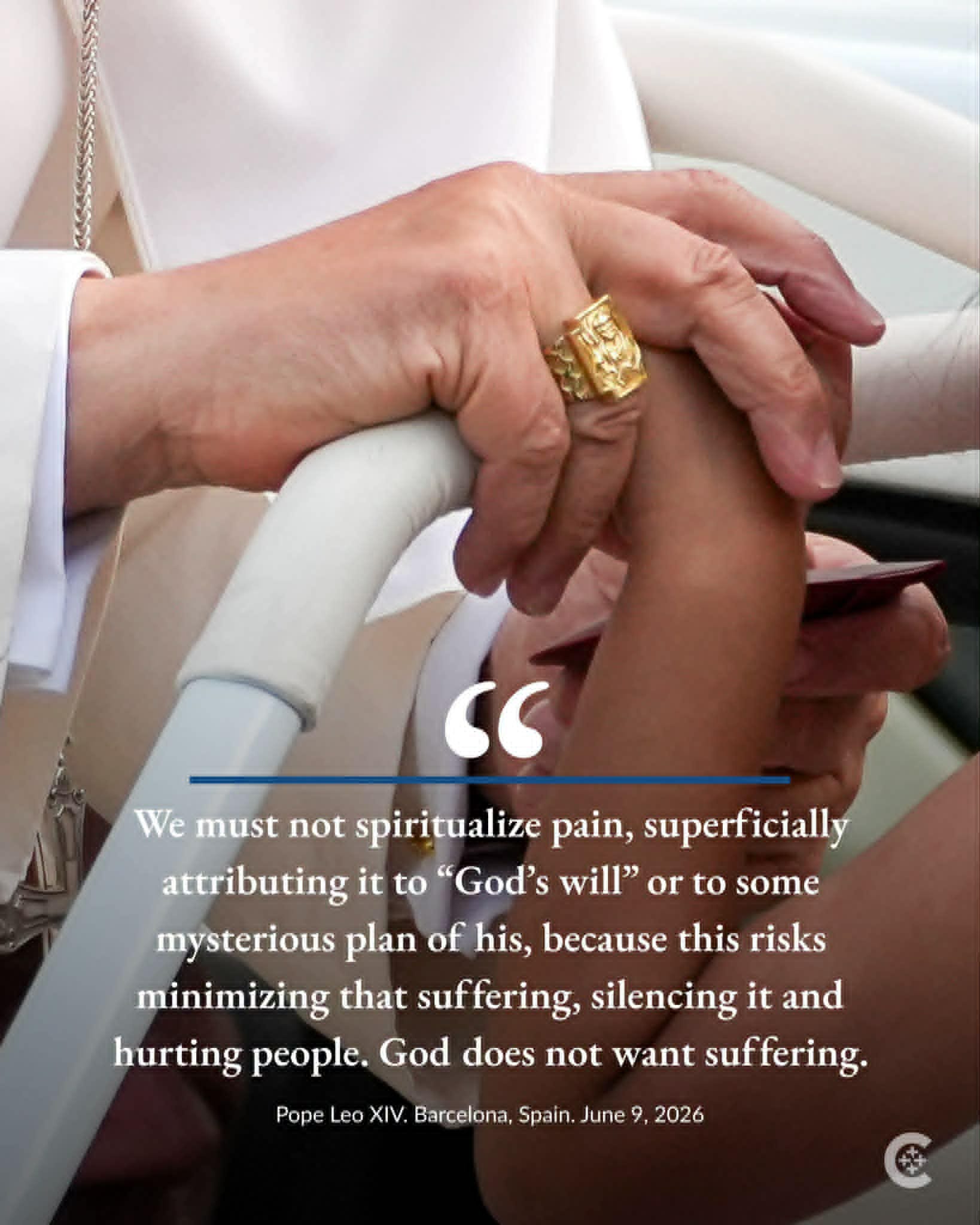
In the past couple of weeks, two readers reached out to me asking if I had ever written anything about how theology about suffering is misused in coercive ways within the Church. Then yesterday, unprovoked, a friend sent me this excerpt from an address Pope Leo gave this past week in Spain:
This won’t be anything like a comprehensive response to how terribly Catholics can speak about suffering, but I’ll offer a couple of reflections.
Where I live in Michigan, my circle of friends will joke about the “up north Masses” we’ve witnessed over the years during our vacations. Pastors who run these rural parishes seem to be able to do whatever they want in the liturgy with, I assume, little to no accountability.
A few years ago I was at an “up north Mass” and...it was beautiful.
It was in a little old wooden church tucked away in rolling hills. The inside was as lovely as the outside: stained glass windows, ornate high altar, beautiful music, and just the right amount of excessive incense.
The church also had a communion rail. And that’s when my inner Trad comes out. I love receiving at a communion rail. It gives me a moment to collect myself and be present before receiving the Eucharist rather than feeling herded through a line.
It was beautiful, until father began speaking. He preached his homily about this line from the first reading that day: “The LORD was pleased to crush him in infirmity” (Isaiah 53:10).
He said that when Jesus took our sins on the cross, Jesus became something that God was pleased to crush and this is how Jesus paid the debt for sin.
I was shocked. I leaned over to Kristina and said, “That’s penal substitutionary atonement. He’s saying that God the Father was happy to crush God the Son. That’s nuts.”
The priest went on and said, from the pulpit: “God’s currency is suffering. And you need to use this life to invest in eternity.”
God’s currency is suffering.
On the drive back after Mass, Kristina and I talked about how our younger selves wouldn’t have thought twice about this priest’s homily. Now it made us feel sick.
Here’s a church full of people, lots of young couples with lots of kids, who need to hear about God’s love and all they got was the priest’s personal paganism presented as authentic Catholicism.
I distinctly remember a family that sat in front of us with six young kids. The oldest was maybe third grade and the youngest was still a baby. The baby dropped something in the aisle during Mass so I grabbed it and gave it to the mom, and she looked so tired. Tired like she hadn’t slept all night. Tired like only a parent with young kids can feel.
I don’t know this woman. I don’t know her family. But I know that feeling. And instead of encouragement, mercy, or the relentless love of God, this homily told her that God wants her to suffer.
This Mass reflected back to Kristina and me what we used to believe about God and Catholicism:
That we must earn God’s grace.
That grace is transactional; I pay in with acts of piety and morality and God gives me a return on my investment sometime in eternity.
That the hard things, the decisions that cause the most suffering, are what God is asking of us.
We really used to believe that God’s currency is suffering.
We believed this because we were told this. Maybe not as starkly as Fr. Edgelord, but that’s how we were formed in the Catholic cultures of our young adulthood. Suffering was subtly presented as a good thing, as something God desires. And this completely undermines the Gospel.
The Church’s teaching on redemptive suffering (re: the Catechism and Salvifici Doloris) is that Christ’s suffering was/is redemptive. God chose to become human, and further yet, he chose to suffer in his humanity in order to liberate from us from suffering and death. Christ shows us that we have a God who walks in solidarity with us, even in the horror of our suffering. And he teaches us that in caring for others who are suffering we are caring for him. Here’s one of many passages about suffering from the Catechism:
“Moved by so much suffering Christ not only allows himself to be touched by the sick, but he makes their miseries his own: “He took our infirmities and bore our diseases.” But he did not heal all the sick. His healings were signs of the coming of the Kingdom of God. They announced a more radical healing: the victory over sin and death through his Passover. On the cross Christ took upon himself the whole weight of evil and took away the “sin of the world.” of which illness is only a consequence. By his passion and death on the cross Christ has given a new meaning to suffering: it can henceforth configure us to him and unite us with his redemptive Passion” (CCC 1505).
The Church is explicitly clear: suffering is evil. It’s a result of sin. It is not desired by God. In fact, saving us from the consequences of sin (suffering included) is the reason that God became man. The Church is clear that part of her mission, the mission of all the baptized, is to help alleviate suffering. The Church warns against turning our back on suffering. From Pope Leo’s exhortation, Dilexi Te:
“The many forms of indifference we see all around us are in fact ‘signs of an approach to life that is spreading in various and subtle ways. What is more, caught up as we are with our own needs, the sight of a person who is suffering disturbs us. It makes us uneasy, since we have no time to waste on other people’s problems. These are symptoms of an unhealthy society. A society that seeks prosperity but turns its back on suffering. May we not sink to such depths! Let us look to the example of the Good Samaritan.’ The final words of the Gospel parable — “Go and do likewise” ( Lk 10:37) — represent a mandate that every Christian must daily take to heart” (DT 107).
However, in this state of “already saved but not yet fully” we still experience some of the consequences of sin, one of which is suffering. In this earthly life, suffering is inevitable. But because of Christ, I can choose to spiritually “offer up” this inevitable suffering, uniting it to the cross, uniting it to Christ’s mission to liberate all of creation from sin and suffering.
In this way, God even allows something as evil as suffering to be a way for me to love others. And sometimes, out of love, I may freely choose to suffer to protect another. “There’s no greater love than this, that a man lay down his life for a friend.”
None of this means that God desires suffering. Nor does it mean that Christians should desire suffering, just muscle through it, or not seek to alleviate it! It’s good to care for myself in my own suffering.
And if somebody else is telling me to just “offer it up” instead of helping me to alleviate my suffering—or worse, if they tell me I should welcome it because God’s currency is suffering—it may be because they are uncomfortable with my suffering. It may be because they don’t want, or feel unable, to accompany me through suffering. But instead of acknowledging their own limitations here (limitations God is pleased to accompany them through), they twist their discomfort into an imposition on others.
I will end here with the longer reflection from that address from Pope Leo in Spain:
“There are moments of darkness and suffering that our society silences because certain cultural norms demand that we always be victorious and perfect, and so our limitations, fragility and pain must be eliminated or confined to the deafening silence of loneliness or even shame. And in these moments, we may instinctively think that God has abandoned us as well. However, the cross of Jesus tells us that God does not abandon us, that he is at our side, crucified with us in moments of pain and extreme loneliness, that he gathers not only our tears but also the cry of our suffering that others do not hear — a cry that Jesus made his own on the cross, saying, ‘My God, my God, why have you forsaken me?’
In a catechesis on the final hours of Jesus, Benedict XVI says that his suffering becomes a cry of prayer, and this is true for us as well: in the face of the most difficult and painful situations, when God seems absent, we must entrust to him once again the burdens we carry in our hearts, even crying out to him, even protesting like Job, confident that in some way he is present and near even when he appears to be silent.
But I believe we cannot do this alone. In times of pain, at least as much as possible, we must open ourselves to someone who can help us utter a simple prayer, who can accompany us with discretion without rushing to explain that pain, who can take us by the hand and lead us out of this cry.
These experiences also offer a message to us believers, to the whole Church: we must not spiritualize pain, superficially attributing it to ‘God’s will’ or to some mysterious plan of his, because this risks minimizing that suffering, silencing it and hurting people. God does not want suffering. He carries it with us and invites us to trust in him with perseverance. Let us remember what Pope Francis said: with God, life is always reborn.”
*AI was used to edit this post
Thank you, Paul for your always insightful and compassionate work. It is a gift to me and to the church. (I am saving this message – there is a lot of stuff here that I hope to include in a book proposal I’m working on over the next year!)
A theology of suffering that ends up decreasing compassion and solidarity, instead of increasing it, isn't the Gospel of suffering. JPII names exactly this in Salvifici Doloris: one reason suffering exists in the world is so that more love can be released into it, not less. He grounds the true Christian attitude toward suffering in the parable of the Good Samaritan — and that attitude, in the end, is Christ's own. He is the true Good Samaritan.