

My wife and I are attending a large Catholic conference as vendors (Kristina is selling her original artwork). I used to love big Catholic conferences.
Ever since high school when I attended Steubenville Youth Conferences, some of my most life-changing spiritual experiences were at big conferences. But I haven’t been to one in over six years, and as my readers would suspect, I have a lot more mixed feelings and skepticism about these things than I used to.
Being a vendor is an opportunity to dip a toe back into an environment that has been filled with real grace and transformation, as well as spiritual abuse and betrayal. It’s a reunion of sorts, revisiting a once beloved space, wanting to see how much old friends have changed…and how much I have.
On the second day of the conference, Kristina and I walked a few blocks from the conference to pick up dinner. As we walked through the urban courtyard dotted with people resting on their backpacks in any small spot of shade, David came up to us and, noticing our conference paraphernalia, asked, “Are you guys Christians for real?” David went on to take off his ball cap to show us a long scar on his head and, after sharing that he has cancer and no access to a doctor, pulled up his old t-shirt to reveal a large lump on his side.
David spoke for several minutes about Jesus before asking for money to pay for cancer treatment. He walked with us a few more blocks and, in front of the restaurant where we were picking up dinner, introduced us to Jennifer.
Even more so than David, Jennifer bore the physical consequences of systemic poverty. She was, honestly, uncomfortable to be around. A discomfort that betrayed my own dis-integrity between my beliefs about poverty and my emotional reaction to speaking with and shaking hands with human persons who are poor and unhoused. She told us she wanted a sandwich from Burger King. She told us she hates being homeless.
Eventually we said goodbye and walked back to the large, air-conditioned conference center to quickly eat our overpriced dinner so we could go back to selling Catholic artwork before we closed up shop for the keynote presentation of the evening. Chris gave the talk that evening. Unlike David and Jennifer, you would know who Chris was. You’ve more than likely been to one of his talks or listened to one of his podcasts.
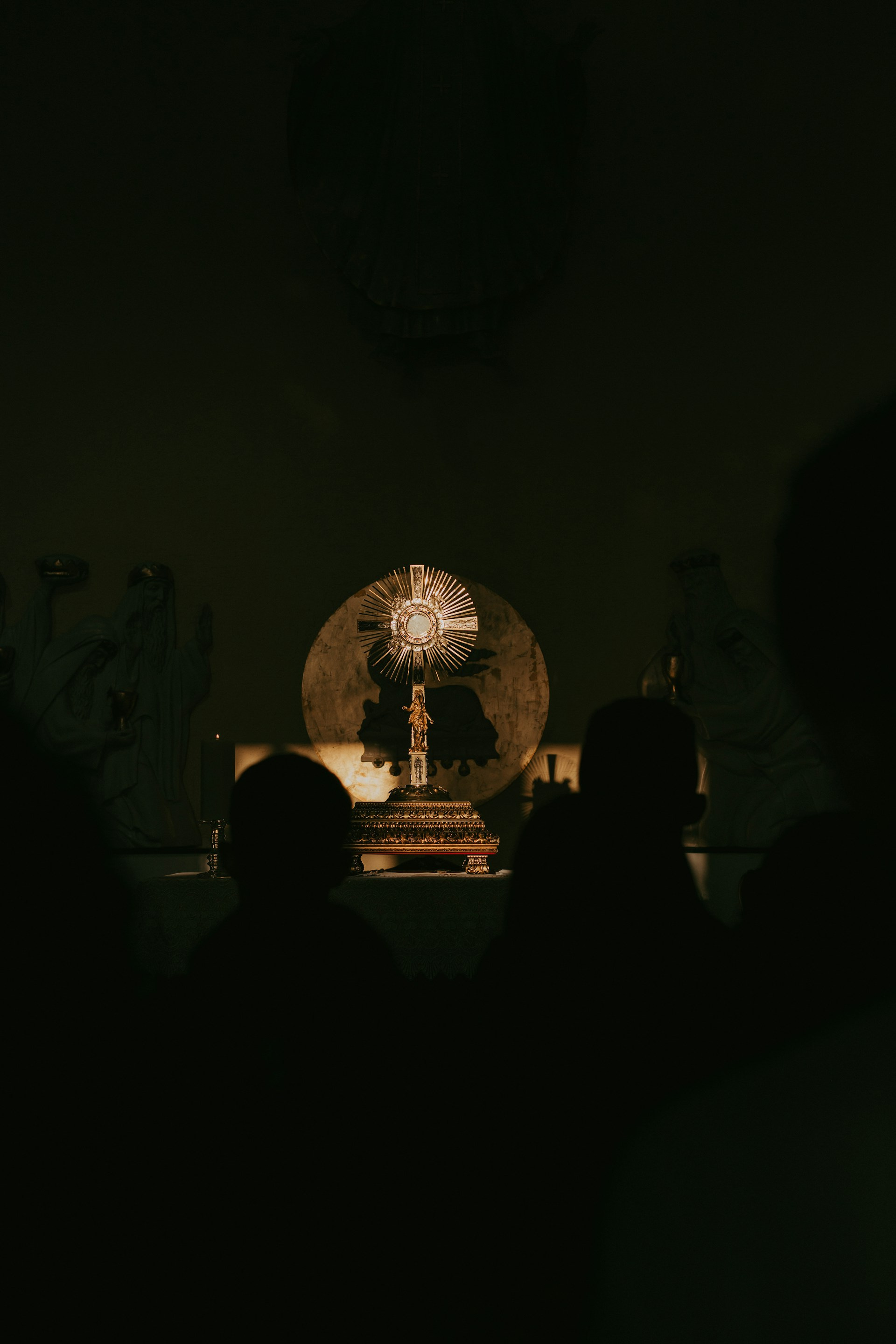
Despite my very mixed feelings about the conference, my discomfort being in a “Rah-Rah Catholicism!” environment, and my annoyance with the previous talk I went to that day—part of me was looking forward to this keynote. Not because of Chris, but because his talk led into Eucharistic Adoration. If you’ve been to a Catholic conference, you know the kind of Adoration I’m talking about. The oversized monstrance, the lights, the praise and worship band, all of it. Again, a space I was very familiar with. An old friend.
That made Chris’s talk feel all the more sad. It started like a right-wing pep rally with barely a mention of Jesus or Scripture. He staked out his definition of masculinity, not primarily by turning to Jesus and the saints as models, but by droning on about how the evil culture is trying to put men down by calling them “toxic” and that women, deep down, really want men to rescue them from their work cubicles. I was angry. And beneath that anger was sadness. This familiar space, which I once found safe and beautiful, has been overgrown with thorns. Or maybe the thorns had always been there and I didn’t have the eyes to see. Either way, it was clear this is a space where my beliefs and experiences no longer fit.
Eventually the music started and a priest processed in with the monstrance. Jesus was here! But of course, He had already been there. In David, Jesus walked with me to dinner. In Jennifer, Jesus spoke with me as I picked up my food. And in Chris, Jesus was there too.
Towards the end of his presentation, Chris moved into talking about how so many people have been harmed by men in their lives, men who were supposed to represent God to them. And at one point he said to this group of 5,000 attendees (and who knows how many people live-streaming), “I don’t think I ever shared this on stage before.” He went on to say that as a child, three different priests “made advances” (his phrasing) on him. Without at all excusing any of the crappy things he said before that, or any of the crappy things he said after, this moment gave his talk (and what he says on his platforms) more of a context. A context shaped by abuse and betrayal from individual men who represented Christ, and from the Church, which is supposed to be the Sacrament of Salvation, not the enabler, protector, and excuser of abuse.
In one of his documents that reoriented my understanding of God and grace, Pope Francis taught:
“Nor can we claim to say where God is not, because God is mysteriously present in the life of every person, in a way that he himself chooses, and we cannot exclude this by our presumed certainties…If we let ourselves be guided by the Spirit rather than our own preconceptions, we can and must try to find the Lord in every human life” (Gaudete et Exsultate 42).
I wrote this reflection while sitting behind the vendor table, and as I was writing, everyone in the hallways went silent and kneeled (myself included) as a priest processed through the halls with the Eucharist on his way to offer Adoration to a breakout group. Whatever grace I’ve been given in order to believe that Jesus is present in this piece of bread on display at a conference—despite the ugliness that’s also on display—is the same grace that convicts me to believe that Jesus is present in David and Jennifer. It’s also the same grace that convicts me to see Jesus in Chris, despite the ways he obscures God’s goodness and causes spiritual harm in the position of authority he has.
I met my Old Friend at this conference. He hadn’t changed, but in the past several years He has changed me a lot. I don’t know if I’ll come back next year. I dipped my toe back in and the water wasn’t very welcoming. But it’s good I met Jesus here this year.
Amen! Thank you, Paul. This resonates with me as I am gearing up to work a conference. We live as members of a Body broken and shared.
Your posting saddened me and I thought of a Richard Rohr quote I’ve been thinking about a lot about recently - "We worshiped Jesus instead of following him on his same path. We made Jesus into a mere religion instead of a journey toward union with God and everything else. This shift made us into a religion of 'belonging and believing' instead of a religion of transformation."