

As Michigan’s primary election quickly approaches, I wanted to share some of my own thought process as I’ve approached discerning who to vote for. I approach voting first and foremost as someone whose conscience has been deeply shaped by the Church’s social doctrines, specifically the belief that every human being has infinite dignity and that the poor and powerless must be given preferential treatment.
For many years, really up until a decade ago, I believed that good Catholics must, in practice, be single issue voters. I also believed there were “five non-negotiable issues,” and that voting for a candidate who supported any of them was a sin. All of this was presented to me as Church teaching.
But it isn’t.
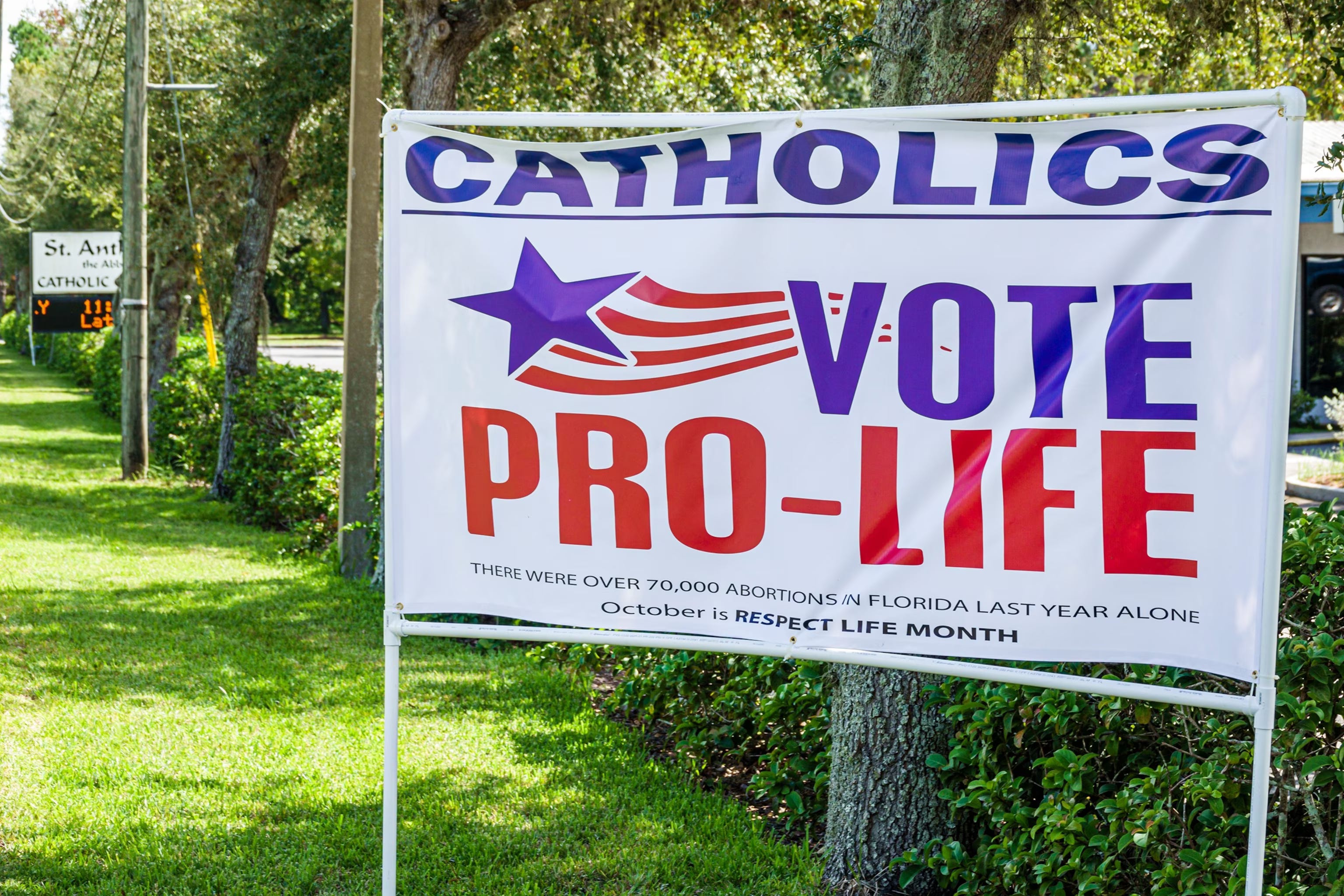
In reality, the Church teaches against single issue voting:
“The Christian faith is an integral unity, and thus it is incoherent to isolate some particular element to the detriment of the whole of Catholic doctrine. A political commitment to a single isolated aspect of the Church’s social doctrine does not exhaust one’s responsibility towards the common good” (CDF doctrinal note, The Participation of Catholics in Political Life, 2002).
And the list of “non-negotiable issues” is much longer than five (and isn’t nearly as partisan). Pope John Paul II offered this not-exclusive list in Veritatis Splendor:
any kind of homicide
genocide
abortion
euthanasia
voluntary suicide
mutilation
physical and mental torture
attempts to coerce the spirit
subhuman living conditions
arbitrary imprisonment
deportation
slavery
prostitution
trafficking in women and children
degrading conditions of work which treat labourers as mere instruments of profit, and not as free responsible persons
Further, the Church acknowledges that someone’s well formed conscience can lead them to voting for a candidate despite their support for some intrinsic evil, especially when there are other grave issues on the line and/or all candidates support intrinsic evils. This is from the US Conference of Catholic Bishops’ document on voting:
“There may be times when a Catholic who rejects a candidate’s unacceptable position even on policies promoting an intrinsically evil act may reasonably decide to vote for that candidate for other morally grave reasons. Voting in this way would be permissible only for truly grave moral reasons, not to advance narrow interests or partisan preferences or to ignore a fundamental moral evil.
When all candidates hold a position that promotes an intrinsically evil act, the conscientious voter faces a dilemma. The voter may decide to take the extraordinary step of not voting for any candidate or, after careful deliberation, may decide to vote for the candidate deemed less likely to advance such a morally flawed position and more likely to pursue other authentic human goods” (Forming Consciences for Faithful Citizenship, 35-36).
All of that to say, for many years I was coerced into believing (look above, that’s on John Paul II’s list of non-negotiables) that I must vote for the Republican candidate and that voting for a Democrat was a sin. It was only through reading the Church’s actual social teaching around ten years ago that my conscience was freed and able to be formed more holistically by the Gospel.
One of my goals in sharing my thoughts about this here is to help you experience that freedom as well.
As I understand and experience the world in 2026 (”reading the signs of the times”) while also being attentive to what the popes are telling me are important, there are three issues being discussed by candidates that I’m weighing heavily as I vote, specifically in some of the federal positions up for grabs this election year. Those issues are:
Ending the Iran War
Abolishing ICE and dramatically reforming immigration enforcement
Implementing universal healthcare
In all of these issues, while politics is the art of the possible, I, rightly or wrongly, remain an idealist. And in the primary, I tend to lean into that idealism more.
Here’s a long, but far from complete, list of passages from Pope Leo, Pope Francis, and other church document that have helped to shape my conscience on these issues.
-War in Iran-
Pope Leo, June 6, 2026
I believe this has already been made very clear: in Iran, the criteria for a just war are not present.
Pope Leo, Magnifica Humanitas 192
Today, more than ever, without prejudice to the right to self-defense in the strictest sense, it is important to reaffirm that the “just war” theory, which has all too often been used to justify any kind of war, is now outdated. Humanity possesses far more effective and capable tools for promoting human life and resolving conflicts, such as dialogue, diplomacy and forgiveness. The use of force, violence and weapons reflects a relational poverty that always has disastrous consequences for civilian populations.
Pope Franci, Fratelli Tutti 261
Every war leaves our world worse than it was before. War is a failure of politics and of humanity, a shameful capitulation, a stinging defeat before the forces of evil. Let us not remain mired in theoretical discussions, but touch the wounded flesh of the victims. Let us look once more at all those civilians whose killing was considered “collateral damage”. Let us ask the victims themselves. Let us think of the refugees and displaced, those who suffered the effects of atomic radiation or chemical attacks, the mothers who lost their children, and the boys and girls maimed or deprived of their childhood. Let us hear the true stories of these victims of violence, look at reality through their eyes, and listen with an open heart to the stories they tell. In this way, we will be able to grasp the abyss of evil at the heart of war. Nor will it trouble us to be deemed naive for choosing peace.
Pope Leo, January 2026
I would like to draw particular attention to the importance of international humanitarian law. Compliance with this cannot depend on mere circumstances and military or strategic interests. Humanitarian law, in addition to guaranteeing a minimum of humanity during the ravages of war, is a commitment that States have made. Such law must always prevail over the ambitions of belligerents, in order to mitigate the devastating effects of war, also with a view to reconstruction. We cannot ignore that the destruction of hospitals, energy infrastructure, homes and places essential to daily life constitutes a serious violation of international humanitarian law. The Holy See firmly reiterates its condemnation of any form of involvement of civilians in military operations. It likewise hopes that the international community will remember that the protection of the principle of the inviolability of human dignity and the sanctity of life always counts for more than any mere national interest.
Pope Francis, March 2022
Why, then, wage war on each other over conflicts that we should resolve by talking to each other as fellow people? Why not rather join our forces and resources to fight together the real battles of civilization: the fight against hunger and thirst; the fight against disease and epidemics; the fight against today’s poverty and slavery? Why? Certain choices are not neutral: to allocate a large part of spending to weapons means taking it away from something else, which means continuing to take it away yet again, from those who lack the basic necessities. And this is a scandal: spending on weapons....We feel it more because it is closer, but there are continuous wars in Africa, in the Middle East, in Asia. This is serious. We need to create the awareness that continuing to spend on weapons sullies the soul, sullies the heart, sullies humanity. What is the use of solemnly committing ourselves all together, on an international level, in campaigns against poverty, against hunger, against the degradation of the planet, if we then fall back into the old vice of war, into the old strategy of the power of armaments, which takes everything and everyone backwards? A war always takes you backwards, always. We walk backwards. We will have to start over again.
-Treatment of Migrants-
Pope Leo, Magnifica Humanitas 81
A litmus test for social justice today is the treatment of migrants, refugees and those forced to move due to poverty, violence, climate change and environmental disasters. The way a society treats them reveals whether its sense of justice is driven by fear or by the spirit of fraternity. Pope Francis urged us to see migrants not simply as a problem to be managed, but as a living image of the People of God on the move. They are people with dignity, resources and dreams, who have the right to be treated with respect and to ask to become active members of the societies that welcome them. Social justice in this area entails at least two complementary commitments. On the one hand, this means protecting the rightful hopes of those forced to leave by ensuring safe and legal routes, dignified conditions for receiving them, and genuine pathways to integration. On the other hand, it means promoting the right to remain in one’s homeland in peace and security by addressing the root causes that force people to migrate, including those linked to economic injustices and the climate crisis. When these rights are respected, migration can become an opportunity for encounter and mutual enrichment among peoples.
Pope Francis, Fratelli Tutti 129-130
Complex challenges arise when our neighbour happens to be an immigrant. Ideally, unnecessary migration ought to be avoided; this entails creating in countries of origin the conditions needed for a dignified life and integral development. Yet until substantial progress is made in achieving this goal, we are obliged to respect the right of all individuals to find a place that meets their basic needs and those of their families, and where they can find personal fulfilment. Our response to the arrival of migrating persons can be summarized by four words: welcome, protect, promote and integrate. For “it is not a case of implementing welfare programmes from the top down, but rather of undertaking a journey together, through these four actions, in order to build cities and countries that, while preserving their respective cultural and religious identity, are open to differences and know how to promote them in the spirit of human fraternity”.
This implies taking certain indispensable steps, especially in response to those who are fleeing grave humanitarian crises. As examples, we may cite: increasing and simplifying the granting of visas; adopting programmes of individual and community sponsorship; opening humanitarian corridors for the most vulnerable refugees; providing suitable and dignified housing; guaranteeing personal security and access to basic services; ensuring adequate consular assistance and the right to retain personal identity documents; equitable access to the justice system; the possibility of opening bank accounts and the guarantee of the minimum needed to survive; freedom of movement and the possibility of employment; protecting minors and ensuring their regular access to education; providing for programmes of temporary guardianship or shelter; guaranteeing religious freedom; promoting integration into society; supporting the reuniting of families; and preparing local communities for the process of integration.
-Universal Healthcare-
Pope John XXIII, Pacem in Terris 11
But first We must speak of man’s rights. Man has the right to live. He has the right to bodily integrity and to the means necessary for the proper development of life, particularly food, clothing, shelter, medical care, rest, and, finally, the necessary social services. In consequence, he has the right to be looked after in the event of illhealth; disability stemming from his work; widowhood; old age; enforced unemployment; or whenever through no fault of his own he is deprived of the means of livelihood.
Catechism of the Catholic Church 2288
Life and physical health are precious gifts entrusted to us by God. We must take reasonable care of them, taking into account the needs of others and the common good. Concern for the health of its citizens requires that society help in the attainment of living-conditions that allow them to grow and reach maturity: food and clothing, housing, health care, basic education, employment, and social assistance.
Compendium of the Social Doctrine of the Church 166
The demands of the common good are dependent on the social conditions of each historical period and are strictly connected to respect for and the integral promotion of the person and his fundamental rights. These demands concern above all the commitment to peace, the organization of the State’s powers, a sound juridical system, the protection of the environment, and the provision of essential services to all, some of which are at the same time human rights: food, housing, work, education and access to culture, transportation, basic health care, the freedom of communication and expression, and the protection of religious freedom.
Pope Francis, Fratelli Tutti 109
Some people are born into economically stable families, receive a fine education, grow up well nourished, or naturally possess great talent. They will certainly not need a proactive state; they need only claim their freedom. Yet the same rule clearly does not apply to a disabled person, to someone born in dire poverty, to those lacking a good education and with little access to adequate health care. If a society is governed primarily by the criteria of market freedom and efficiency, there is no place for such persons, and fraternity will remain just another vague ideal.
Sir, a few things. You sully yourself using the pejorative “Democrat” pushed by President Trump and Fox News as childish name calling. To be taken seriously, use “Democratic Party” to grant the human beings who are members of that group the respect and dignity they have as fellow children of God.
Certainly, disagree with their policies, but there is no need for the childish mocking.
Also, while Trump, tepidly, supported the overturn of Roe v. Wade, it was, in fact, not him, but the State of Mississippi's suit that brought the case before the Supreme Court.
I share your view that abortion is a grave sin and goes against God’s love of life as our Creator. However, so are: the too high death of children and mothers in childbirth in our country, one of the worst in the developed world, the huge number of children and elderly living in poverty, the substandard and cruel conditions in nursing homes, the murder of innocent people and cruelty toward immigrants displayed by CBP and ICE at the behest and encouragement of the president, the huge, heartbreaking number of people, especially children, killed by gun violence, the ending of USAID to poor, hungry nations resulting in millions of deaths by starvation, famine and disease, the foolish wars and bombings of choice and the failure to denounce Russia’s war crimes against Ukraine, and more.
These, too, are issues of life and death. I stand with you in your opposition to abortion. I ask you to stand in solidarity with me against all areas that rob life from all God’s children, from conception to natural death. No matter which politicians we choose to vote for, we should hold all of them to account to be, truly, fully pro-life.
Thank you very much for this, Paul. It moved me to tears.